Wednesday, July 3, 2013

A most dangerous habit

So, what do you have to say about those who read books? Those who, that is, love reading them, are always found with them and have gathered a reputation as 'voracious readers'?

There is the regretful voice of teachers and mothers who think that internet and sms have brought doom and gloom to the future of their children who simply don't want to pick up a book. You hear conservationists campaigning for keeping the reading habit alive. If you listen to this group, you must think that reading must be a blessed preoccupation indeed. And we have read those numerous poems from Englishmen encased in nobility who have sung to the glory of books.

But think of witty women, headstrong women, women with opinions like Lizzy Bennett. Women who think, who dare to knock at the doors of universities like Virginia Woolf. Women who like to read about women like them, women who read and agree with the opinions of women and men like them -- no, I am not talking about the 'feminists' alone, though they may certainly be part of this group.

To be found with a book suddenly becomes the opposite of cooking, wiving (no, that's not the right word, is? It should be 'husbanding' -- now 'husbanding' has a pretty domestic air about it), mothering and all those cultivated, feminine things that a woman must do. If she reads in spite of them, some kind of little novel or poetry book as deemed fit for the fairer sex since the eighteenth century, reading is again a good habit, ain't it?

For the most part, however, women would like to keep their intellect and their habits intact, methinks. Women who read, like women who think and women who study and women who assert their rights are dangerous creatures.

So, would you encourage your girl child to read?

Wednesday, June 12, 2013

The first lesson again


Today, I learnt Swati Tirunal’s oft-heard kriti in Mayamalavagoula, ‘Deva deva kalayaami’. The familiar intonations of the beginner’s raga completed yet another cycle in learning music. “Anda ga-va-attara ashakanam” said my teacher reminding me that the Ga in Mayamalavagowla contained glimpses of three notes. Another of the realisations that form the everyday in learning and relearning music. 

Sa-Ri-Ga-Ma... and so on we are taught in that very Mayamalavagoula  in our very first class on Karnatik music. Then to now is a long way indeed, as is now to the many ‘then’s in future!

Meanwhile, George Lakoff and Mark Johnson here are telling me how reason is not completely conscious but mostly unconscious. That it is shaped by the body, and constrained by it. That we deal with a cognitive unconscious. How we learn in spite of our fundamental unconsciousness of the way we learn has always hugely intrigued me. And even as I try to consciously understand, through speculation and science, through the bizarre language of neurons and through the pleasure of having consciously realised what I have half-known for years, I find myself equally interested in tapping our unconscious learning abilities to enhance our methodologies of education as well as our creative endeavours.

To end this post, I like what Rashmee said the other day on FB: art helps digest. I would like to add, art helps rearrange. As we rearrange, add or brush off a shade, a note, an imperceptible so much here and there, much more than the shade or note, picture or tune, gets rearranged.  And that could be potentially as big as the butterfly's flapping wings.

Monday, December 31, 2012

The tide country, at last!


“The islands are the trailing threads of India’s fabric, the ragged fringe of her sari, the ãchol that follows her, half-wetted by the sea. They number in the thousands, these islands; some are immense and some no larger than sandbars; some have lasted through recorded history while others were washed into being just a year or two ago... The rivers’ channels are spread across the land like a fine mesh-net, creating a terrain where the boundaries between land and water are always mutating, always unpredictable. Some of these channels are mighty waterways, so wide across that one shore is invisible from the other; others are no more than two or three kilometres long and only a few hundred metres across. Yet, each of these channels is a ‘river’ in its own right, each possessed of its own strangely evocative name. When these channels meet, it is often in clusters of four, five or even six: at these confluences, the water stretches to the far edges of the landscape and the forest dwindles into a distant rumour of land, echoing back from the horizon.”

Amitav Ghosh, The Hungry Tide (2004)

This is where it began. For eight long years, since the first time I read these paragraphs, the tide country has been a constant, haunting image in my mind: one of my most desperate dreams, so to speak. When Vidya and I booked a tour package to the Sundarbans via India Beacons Sojourn this September, I consciously stopped imagining, expecting, looking forward. It was too intense, what I held within myself for this place, its creatures and its people. I was only thinking of a week-long holiday in December, so hard-earned for both of us.

Kolkata was a lovely welcome and meeting a dear online friend for the first time was already one wish granted. Shantiniketan, an artist-town, was a perfectly planned holiday complete with many take-aways. And then, before we knew it, we were at Science City, Kolkata on the morning of Friday, 14th of December, waiting for our pick-up to Godhkhali from where we were to be taken to the Sundarbans on a launch. After some initial mix-up with the directions, we joined a group of 8-10 people, pinching ourselves, at the brink of an experience that heaped rewards on my years of waiting.

The launch that greeted us at Godhkhali was called Purbasha. Dipankar Mondol and the other members of our crew (our ever-smiling driver Bhola and our expert cook Lala) took us aboard while the rest of the group that had travelled with us so far was put on another launch. We learnt later that the group that was to come with us had cancelled plans last minute. Surprise was the way Bon Bibi granted us our best holiday to date. The only travellers on our boat for two-and-a-half days, Vidya and I found ourselves negotiating stretches of water surrounded by mangrove forests – exactly as Amitav Ghosh describes the islands.

Purbasha is not just a launch, it is a household, complete with a well-equipped kitchen and comfortable bunk-beds on the lower deck, a neat little cubicle of a washroom and luxury encapsulated in its simple amenities. After a couple of hours – during which time we were served the first of our scrumptious meals on board – we reached the Sajnekhali watch tower. Crocodiles and deer were visible in the distance. The experience of peering through the binoculars, searching the mangrove forests and the waters for sightings, is something I cannot describe here in words, try as I might, though I can still hear the swish of the tides and feel that wind on my skin as I write this.

The Sajnekhali and Sudhanyakhali watch towers are well-maintained posts, the former housing a beautiful museum on the ecology of the Sundarbans, a cluster of islands densely forested with 84 species of mangroves, only a small part (about one-fifth) of which lies in India and the rest in Bangladesh. The rivers that criss-cross this region are now cut off from the Ganga and it is only the Bay of Bengal’s saline water that flows here. Everywhere as we moved on the waters we saw nets on the banks, supposed to stop the famed Sundarban tigers from emerging out of the forests and attacking the populated parts of the tide country. But that, of course, is no guarantee of safety. As our guide of the third day, Sanyasi Mondol, told us, no villager believes the tiger count given by the Forest Department (a recent census revealed the total number to have shrunk alarmingly) and many fishermen risk their lives by rowing into narrow channels with dead ends. A tiger can leap from the bank, grab you while you are on the boat and be gone silently many minutes before your companions realise you are missing. Why, most of the victims would die of a heart attack at the mere sight of the ferocious animal, even before it has got to them! Mondol claimed that in and around his village, some twenty people had been carried away in the past six months. We found the statistics hard to believe, but while we were there, it seemed too likely.

Life is far from easy around these parts. To the visitor, these islands are a beauty past compare, but would the villagers in these harsh regions, given a choice, have lived here? Poor fishermen and honey collectors risk their lives everyday even as the catch/produce they gather is exported all over the world. In parts, women walk for five to six hours on kaccha roads (banks, really) to get from one place to another. Although there are some schools here, the nearest college is in Kolkata. And medical care is almost non-existent beyond some rudimentary first aid. Tourism seems to have brought some hopes to young men, but I must add that the behaviour of the average tourist leaves much to be desired. It was, however, encouraging that Dipankar's brother had become a professor in a college and though he now lived away from his home country, was avidly promoting its economy as well as ecotourism there through the Purbasha Helpline Society.

The first two days were spent on the launch till 4 pm. Deer, monitor lizards, kingfishers in a jubilation of colours, cormorants, bee eaters, pond herons and the like filled our world with the sort of company we long for but seldom have. The thrill that a sighting brings to a traveller in these regions is incomparable to any other joy. While it is, doubtless, a photographer’s paradise, even to have captured the moments with your overjoyed eyes creates a memory of a lifetime.  

No, we did not see a tiger. That one ultimate wish remained unfulfilled though we experienced the thrill -- as well as the chill -- of an imminent glimpse on the third day as we sat on a country boat that took us terrifyingly close to the forested banks where a tiger could have been crouching, ready to spring on us and take its pick from amongst the group. That ride is unforgettable, what with our boatman Sujit Bidda guiding the boat through the high tide with nothing more than a stout bamboo stick, in a display of astounding strength and control. Our company was complete with a little Tutul (here, Rahul) and we were travelling along the banks of Morichjhãpi – I couldn’t have asked for more! That village with a bloody history now lies deserted, a no man's land whose scars remain unhealed.

Forest faces village across about a quarter of a kilometre of water. Our resort stood at the edge of the inhabited island, in the village of Dayapur, and we could have seen a tiger from our balcony if one had chosen to emerge. I could not help remember the episode in the novel where Kusum’s father is killed by a tiger even as villagers watch and hear helplessly from the other bank the sound of his neck bone cracking in the tiger's grip.

After 4 pm on both the days, we were escorted back to the Royal Bengal Resort. The islands have no electricity, but the tourist resorts run on generator were yet another surprise for us. We got to see an enactment of the Bon Bibi legend by a local women’s group on the very first evening. The play was done laudably: the acts, the songs and dialogues (even though they were in Bangla, a language we don't follow, the drama was good enough to keep us riveted), not to mention the costumes, brought this jungle-lore alive before us. 

On the last day, we travelled on the Baba Vishwanath – another, smaller launch – and were taken to see the farmland and settlements in the village of Charkerighar. We walked across an embankment, taking in the destruction wrought by the cyclone Alia, signs of which were everywhere. Alia had flattened the human settlements completely and ripped apart the manmade banks. The ‘farms’ in the tide country are not as one would visualise them in other parts of India. Imagine land floating on water, here rising and there sinking. Water finds its own way into little and big inlets and reminds you in no uncertain terms, lest you forget your school geography, that it is water that dominates the planet and that land is a mere digression.

Vidya has uploaded a few pictures here.

Monday, May 14, 2012

The Horizon Beyond the Arabian Sea

Sand, trees and wind
Awaas curving into the distance


It is a peculiar experience to stand looking out into the sea at the Gateway of India, with the magnificent concrete jungle behind you. Head deeper into the waters in a catamaran and you see in the distance a difference in the colour of the water a few miles away -- a while sheet by a shore lined with coconut palms swaying in the wind. Mumbai and Alibaug stare at each other across the ocean and a regular stream of tourists from the city escapes to the beaches on weekends.


We decided to avoid both the weekend crowd  and the popular, commercialised Alibaug proper. Thanks to Rushikesh for recommending the other beaches along the coast and the suggestion we look for a homestay . The idea appealed to us and after some searches on the internet, we zeroed in on Shree Holiday Resorts at Chondi, near Kihim beach. Owned by Mr. Kaustubh Raut, it is his ancestral property, a pretty courtyard full of coconut trees with his own home and a separate building with neat rooms for guests. The pleasure of living for a couple of days in this simple and clean small town home will remain a fond memory for many years.

The journey by ferry was itself unique. On our way to Mandwa we decided to take the PNP catamaran at 8:10 am. It had been a while since Vidya and I had set out on one of our short trips. Our last one was Matheran back in July and we were eager to enjoy this one to the fullest before a new hectic phase full of work.

The ferry reached Mandwa jetty at about 9:00 am and the connecting bus soon dropped us at Chondi. Shree Homestay is located along the main road to Alibaug which made it very convenient for us to travel to places nearby. Mr. Raut welcomed us with some delicious upma and tea for breakfast. The food we had on the two days -- "very simple food" as our host described it -- was scrumptious Maharashtrian homemade cuisine with usals and daals and sabjis like paneer burji and gavarchi bhaji. Needless to say, we relished every morsel served fresh and hot.

We spent the afternoons on the courtyard playing carrom and having a go at the glorious hammocks and swings. I felt like a child again: the place is just so lovely you cannot stop gurgling all the time.

Vrindavan -- a private park, nursery and plantation just a few feet away from our homestay -- was full of different kinds of plants. Hot as it was, we could just about roam through the grounds before returning home for lunch. But even in the sunny weather, we hungrily took in all the greenery around, the rare plants and the hills in the distance. In a mere couple of hours were in a place starkly different from Mumbai. It was a break in the true sense of the term. I kept imagining how beautiful the landscape would look when the monsoon sets in.

On the first evening we visited Kihim beach which was barely three kilometers away. Most of the auto rickshaws have no meters here, so you have to believe and give what the auto driver asks. However, the distances are quite long, and the small autos are engaged only to places that lie away from the main roads. On the whole, we found that the local people guided us quite well. Obviously, it is much more convenient to get around in your own vehicle, but I personally enjoyed immensely the opportunity to explore travelling in the local buses as well as the six-seater shared autos (which actually seat some 10 people ;) ) and vans plying from Alibaug to Saswane/Rewas, taking and dropping off passengers at various points.

Kihim was rather muddy at low tide, a little littered and more crowded than Awaas which we visited the second evening. But still it is hardly commercialised in comparison with Alibaug. We did head to Alibaug from Kihim (that would have been a good ten kilometers) and here the most exhilarating experience was the horse cart ride at dusk along the curve of the beach and right into the waters as well! We left the dear  animals with a caress, carrying back the thrill of horses' hooves galloping through waves in the falling darkness, the sea fort in silhouette against the horizon.

On the morning of the second day (11th), we set out to trek up to the Kankeshwar temple. Very enthusiastically, we got up early and left by 6 am. But the town was still asleep and we had to wait for nearly 50 minutes to get an auto which dropped us beyond a railway line some distance away from the foot of the hill. By now the summer sun was already shining down upon us and, in spite of my admonishing, refused to go hide behind the hill and let us climb in peace. The climb was not difficult as treks go, but yours truly was a bit tired, what with the heat and the newly acquired rotundity. Vidya was patient as I kept stopping and disbelieving signs that announced the number of steps yet to be conquered. When we began to climb it looked as though the summit would not be very far as it was a small hill. But the peak and temple at the top were hidden from view, so that the climb was actually much longer. Nonetheless, I enjoyed every bit of it, most of all because hardly a soul was in sight. For the two of us, this was the best aspect of the trip.

After a stop at a Maruti temple with a water tank nearby, we reached the main Kankeshwar temple of Lord Shiva. After meeting all the gods, we had breakfast at a small dhaba and headed back, clicking some snaps of the landscape on our way down.

The second evening had more cheer in store for us. Karmarkar Shilpalay, a small building that houses the creations of the sculptor in his own home, was another enjoyable experience. We spent an hour admiring the statues that surprised us with their life-like quality. The cow in the backyard looked so real it could have mooed right there, and the servant who sat by the gate was as convincing as a man in flesh and blood. The caretaker narrated an anecdote of how the statue was once mistaken for a man by visitors in the late evening who complained of his impertinence when he did not respond to their greeting.


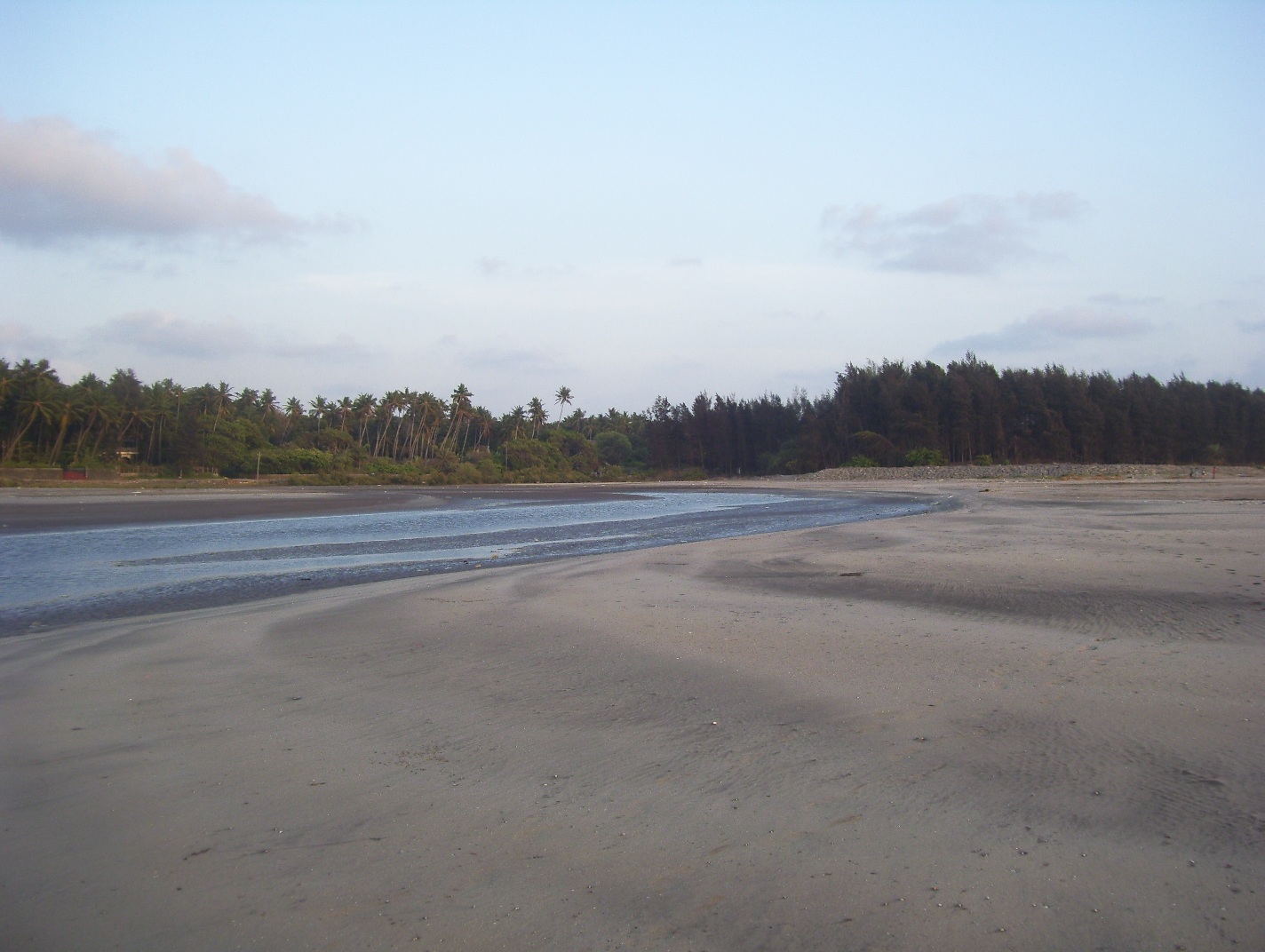
Awaas beach was the perfect climax of our holiday. We walked through a lane flanked by some enviably green and dense private property on either side and suddenly emerged into a vast, vast expanse of beach. Not a single juice stall or ice-cream seller was nearby and the beach waters roared magnificently in the hour immediately after high tide. We walked on the beautiful patterns formed by the sand admiring the bend of the water into the beach and the long coast. Mumbai is a white blur of ghostly sky scrapers at a distance from here. I could just not have enough of the salubrious breeze, the colourful shells on the shore and the amazing formations of sand and water. We took in the calm, the space and the air sitting on the rocks and walked about feeling a world of peace about us.

On the morning of the 12th, we clicked a few pictures of our homestay and waited on the main road outside the resort, where the Maldar pick up vehicle arrived on schedule and took us to Mandwa jetty. The Maldar catamaran is spacious and well-kept: the upper deck has fine seating arrangement and a good roof against the sun. The journey back was a bit rough in the beginning due to the direction of the wind, but the feeling of being back on the waters was a thrill once again.


All good things must come to an end and so did this most satisfying and utterly beautiful trip, but like the best things, it brought a fresh lease of life that is sure to tide us over several months and have a place among our dearest memories.


Saturday, December 24, 2011

A year of achievements

1) Learning to cook for real, to experiment with cooking, to cook traditional dishes and coming to really enjoy the activity.
2) Learning to keep house and coming to enjoy that too!
3) Understanding a particular -- and very peculiar -- kind of mental make up which is most of the time enraptured with numbers and displays special feelings for engines.
4) Coping with quizzical looks in return for looks that say "I need attention because I am sad."
5) Swallowing a sleepy (make that 'sleeping') grunt in reply to "Bye, I'll miss you."
6) Accepting that "haan" or "hmm" can be a logical reply to an intense expression of affection.

In short, learning to live with a member of the male species who needs to be fed regularly in large quantities and who on the whole has the personality type of an algorithm.  Congratulations to me.

Tuesday, December 20, 2011

Miles to go

... before I sleep.

How many more?
Strength to face, strength to rise and strength to end. I must have.

Monday, August 15, 2011

Music Immortalised

So my blog has been lying neglected for more than a year! An MPhil and a marriage surely cannot be that awful. Yet, they, and all the attendant changes and some unexpected dips and drops in terms of mood have taken a toll on my writing. And music.

It’s been a while since I returned to Mumbai and though God alone knows where I might be a few months from now, I have been unsuccessfully trying to decide whether and how to resume music class. Besides, singing itself is just not happening. Blame the inspiration that refuses to strike. The imagination has curled up in a hospital bed and the voice just... doesn’t... lift.

But this blog post was meant to be about a book. I read Vikram Seth’s An Equal Music in Bangalore. Its intensity caught me by surprise and though the plot is sometimes downright trite (all those contrived twists and turns about Julia hiding her deafness, the unconvincing story of a quick and long separation and Julia’s sudden marriage not to mention an ending that combines a predictable climax with an open conclusion), the best in the book is devoted almost exclusively and most exquisitely to music itself. The thrill of finding the Beethoven string arrangement or choosing The Art of the Fugue for an encore admittedly cannot mean for me what it means to a reader more closely familiar with Western classical music, but it did strike a most tuneful chord.

Michael’s intimacy with his violin matches his yearning for Julia and this is a relationship described with great poignancy. The recovery of the Tononi becomes almost a recompense for the inevitable loss of Julia and saves for Michael  more than a history and a profession. The book talks like only a musician can, one who almost vanishes at the moment of making music. Such being the intensity in the novel, Michael’s neurosis, though exasperating, conveys piercing sorrow even in its obstinate self-torture. The pain is also present in Julia’s sinking sense of hearing that carries away from her what matters more than anything else to her, and it is as much conspicuous in her inability to share this language with anyone in her family. Which is why the guilty passion found again but foredoomed creates an unbearable despair amidst so much beauty in the landscapes of Vienna.

Although the novel ends sentimentally, for anyone who has known despair, irretrievable loss and the drowning swell of music that heals only as much as to keep alive and revive memory, these words may mean something:

Music, such music, is a sufficient gift. Why ask for happiness; why hope not to grieve? It is enough, it is blessed enough, to live from day to day and hear such music – not too much or the soul could not sustain it – from time to time.